


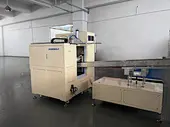
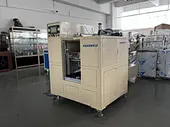
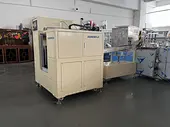
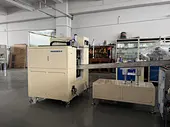
Dual-station curling machine
HSD-2030
Equipment Workflow: Once a cylinder is placed into the workstation—defined by a central shaft and retaining discs—and clamped, the heating heads or hemming rollers advance toward both ends simultaneously. Through thermal softening or mechanical pressing, the edges at both ends are hemmed in a single operation, eliminating the need to flip the workpiece.
Typical Equipment Specifications: Fully automatic dual-station cylinder hemming machines generally accommodate cylinders with diameters ranging from approximately 30–200 mm and heights from 15–420 mm. The production cycle is roughly 3–8 seconds per side; the equipment operates on a 220V power supply and utilizes an air pressure of 3–5 kg/cm².
Typical Equipment Specifications: Fully automatic dual-station cylinder hemming machines generally accommodate cylinders with diameters ranging from approximately 30–200 mm and heights from 15–420 mm. The production cycle is roughly 3–8 seconds per side; the equipment operates on a 220V power supply and utilizes an air pressure of 3–5 kg/cm².
Quantity
Material Feeding and Cylinder Forming: An operator loads a full roll of PVC or PET sheet material onto the cylinder-forming machine. Once the equipment is activated, the sheet is coiled into shape, secured via ultrasonic welding or adhesive bonding, and cut to size to automatically produce a cylinder. The cylinder is then transported—either by a conveyor belt or a robotic arm—to the flanging/curling station.
Automatic Flanging/Curling (Three-Station Simultaneous Operation): Upon entering the flanging machine, the cylinder is positioned into the flanging mold by a robotic arm or a clamping fixture. The equipment heats or pre-compresses the edges at both ends of the cylinder; the flanging mold then descends and rotates, curling the edges inward. A key feature of this production line is the inclusion of three separate flanging stations, which can process three cylinders simultaneously, significantly boosting efficiency.
Robotic Unloading: Once the flanging process is complete, a robotic arm—triggered by a signal—enters the station, grips the finished cylinder, and places it into the collection area. This concludes the entire production process for a single unit.